Yana Skakun

Why an 11am Ceremony is a Timeline Mistake (And What to Do Instead)
By Yana Skakun·10 July 2026·8 min read
Registrars love an 11am ceremony. Venues love it too, because it fits neatly into a single day of turnover between wedding parties and gives caterers a clean run at lunch service. But as a wedding photographer who has shot enough of these to spot the pattern, I can tell you that 11am is very often the single decision that causes the most stress on a wedding day timeline. It sounds early enough to leave a long, relaxed day ahead of you. In practice it compresses everything that needs to happen before the ceremony into a morning that was already too short, and it pushes some of the best photography of the day — portraits, couple shots, golden hour — into slots that do not exist or that arrive at the worst possible time of year. This is not a reason to panic if your ceremony is already booked for 11am. It is a reason to plan the rest of the day around that time deliberately, rather than assuming it will simply work itself out.
Why 11am Feels Safe But Rarely Is
On paper, an 11am ceremony looks generous. It is not first thing in the morning, it leaves the whole afternoon and evening free, and it gives the impression of a relaxed, unhurried start. The problem is what has to happen before 11am, not after it. Hair and make-up for a bride and a full bridal party typically takes three to four hours from the first person in the chair to the last touch of lipstick. If hair and make-up needs to be finished with enough buffer for the bride to get dressed, have some quiet time, and travel to the ceremony venue, the artists are often starting at 6am or earlier. Add a getting-ready location that is not the ceremony venue, a dress that takes fifteen minutes to fasten correctly, and the inevitable ten minutes lost to someone not being able to find a shoe, and the morning becomes a sprint rather than the calm, photogenic build-up that couples imagine when they picture their wedding morning.
I have shot enough 11am ceremonies to know that the getting-ready photographs — often some of the most genuinely emotional and unscripted images of the whole day — are the first casualty when the morning runs short. Everyone is watching the clock instead of enjoying the moment, and that tension shows in photographs even when nobody says a word about it.
The Real Problem: What Comes After the Ceremony
A church or civil ceremony at 11am typically finishes somewhere between 11:30 and noon, once confetti, congratulations, and the general scrum of guests filing out is accounted for. That leaves a window before the wedding breakfast — usually scheduled for early-to-mid afternoon — for family formals, group photographs, and, most importantly, portraits of the couple. In midsummer that window is genuinely workable, because the light through early-to-mid afternoon in the UK, while harsh overhead, is at least abundant and long-lasting. But for a large portion of the year, an 11am ceremony pushes couple portraits into the least flattering light of the entire day: the flat, high, contrasty light of midday, with harsh shadows under eyes and squinting rather than the soft, directional light photographers actually want.
The knock-on effect is that by the time the wedding breakfast, speeches, and any interval activities are finished, the afternoon has often run long, and the couple ends up with no dedicated portrait time at all before the light fades — or worse, they are pulled out for ten rushed minutes between courses, in the one part of the day when they most need to actually enjoy being married rather than performing for a camera. This is the pattern I see most often when I work as a wedding photographer across the UK: couples who love their photographs from the morning and the reception, but who feel something is missing from the middle of the day, because the middle of the day was never properly protected.
Golden Hour Becomes an Afterthought, Not a Plan
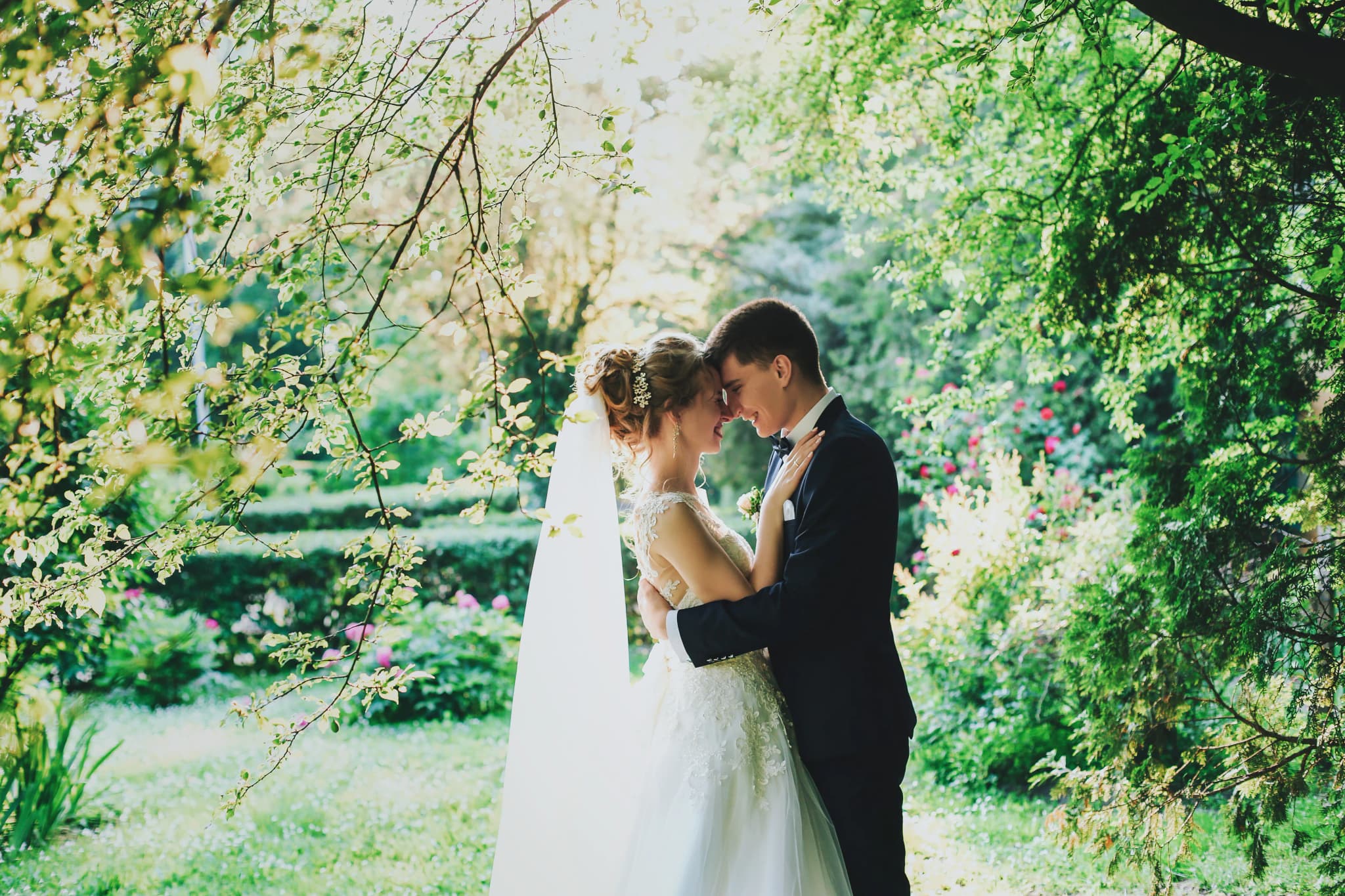
Golden hour — the hour or so before sunset when the light turns warm, low, and soft — produces some of the most requested images from any wedding gallery. With a ceremony at 1pm or 2pm, golden hour naturally falls somewhere in the reception, and it is easy to step outside for twenty minutes without disrupting anything. With an 11am ceremony, golden hour in British summer can fall as late as 8:30 or 9pm, deep into the evening reception, by which point the couple has usually settled in, guests are dancing, and pulling the couple away feels like an interruption rather than a natural pause. In winter, when sunset can be as early as 3:45pm, golden hour might arrive during the wedding breakfast itself, meaning it either gets missed entirely or the couple has to leave their own meal to catch it.
None of this means golden hour portraits are impossible with an early ceremony. It means they need to be planned for explicitly, with a specific slot named on the timeline rather than left as a vague hope that "we'll pop out at some point." I always ask couples with early ceremonies to build in a genuine ten to fifteen minute window during the reception, ideally agreed with the venue coordinator in advance, so that stepping away does not feel disruptive to anyone and the moment is not lost to a full dance floor or a delayed dinner service.
A note on planning your timeline
If your ceremony time is already fixed, the fix is not to change the ceremony — it is to build the rest of the day around it with intention rather than hope. I go through a full timeline with every couple before their wedding, working backwards from ceremony time to figure out exactly where portraits, family groups, and golden hour need to sit so nothing gets squeezed out. It takes about twenty minutes and it is the single most useful conversation we have before the wedding.
Get in touchWhat to Do Instead: Building a Timeline That Protects the Photography
The single biggest improvement I recommend to couples locked into an 11am ceremony is a first look, held before the ceremony rather than relying entirely on the traditional reveal at the aisle. A first look moves a large chunk of couple portraits and even some family formals into the morning, before the ceremony, when the light is often softer and the day has not yet accumulated delays. It sounds like a big departure from tradition, but in practice most couples who choose it say the quiet, private moment of seeing each other before the ceremony becomes one of their favourite parts of the whole day, precisely because it is unhurried and just the two of them, rather than a thirty-second aisle moment shared with 100 guests.
If a first look is not right for you, the next best option is ruthless honesty about how long each stage of the morning actually takes, and building buffer time into every single one of them. Hair and make-up should have a hard finish time at least ninety minutes before the ceremony, not thirty. Travel time between getting-ready location and venue should assume traffic and parking delays, not the fastest possible driving time. And group and family photographs after the ceremony should be planned with a written list in advance, agreed with both families, because an unplanned list is where twenty minutes silently disappears while people try to locate Uncle David.
For couples planning a smaller, more intimate day, moving the ceremony itself later in the afternoon, or choosing an elopement or small ceremony format, sidesteps the entire problem, because there is no large guest list and extended family schedule to coordinate around. It is not the right choice for every couple, but it is worth knowing it is an option if timeline pressure is a genuine source of stress in your planning.
Talk to Your Photographer Before You Confirm the Ceremony Time
This is the piece of advice I wish more couples heard before they booked their venue and registrar slot, rather than after. If you have any flexibility at all in choosing your ceremony time, involve your photographer in that decision. I can tell a couple in five minutes what a 10am, a 12:30pm, or a 2pm ceremony will mean for their light, their morning schedule, and their evening portraits, because I have shot enough weddings across the full range of ceremony times to see the pattern repeat every season. A conversation at the booking stage can save a genuinely stressful morning six months later.
If the time is already locked in, all is not lost — the vast majority of weddings I photograph do not have perfect timelines, and they still produce beautiful, honest, well-covered days. The point of raising this is not to create anxiety about a decision you have already made. It is to make sure that if 11am is your ceremony time, the rest of your day is built around it with the same care as the ceremony itself, rather than assumed to simply fall into place.
A Sample Timeline for an 11am Ceremony
To make this concrete, here is roughly how I would structure a summer wedding day around an 11am ceremony, working backwards from that fixed point. Hair and make-up begins at 6:30am for a bridal party of four, with a hard finish at 9:15am. Getting-ready photography runs from around 8am, once there is enough happening in the room to photograph properly, through to 9:45am when the bride is dressed. A short first look and ten minutes of relaxed couple portraits follow from 10am to 10:20am, giving genuinely soft morning light without the pressure of a full portrait session. Guests are seated by 10:45am, ceremony begins at 11am and finishes around 11:35am, followed by confetti and congratulations until noon. Family formals run from 12pm to 12:30pm using a pre-agreed list, leaving a short window for a handful of additional couple portraits before the wedding breakfast begins at 1pm. A ten-minute golden hour slot is then pencilled in for around 8pm, agreed with the venue in advance, before the evening reception continues uninterrupted.
This is a template, not a rule, and every wedding needs adjusting for travel distances, venue layout, and the specific preferences of the couple. But the principle holds regardless of the details: name every stage of the morning, give it a realistic amount of time rather than an optimistic one, and protect at least one deliberate window later in the day for the portraits that will matter most once the day is over.
If you are planning a wedding around an early ceremony time and want help building a timeline that actually works, I would be glad to talk it through with you. As a Cambridge-based wedding photographer I build a full timeline with every couple I work with, whether the day starts at 9am or 3pm, and I would rather have that conversation three months before the wedding than discover the gap on the day itself. You can see more about how I approach a wedding day on the pricing and collections page, and I would love to hear about your plans — get in touch whenever you are ready.
Yana Skakun
Photographer · England
Professional wedding, family and portrait photographer based in England. Passionate about capturing authentic emotions and timeless moments.
About Yana →11am wedding ceremony timelinewedding day timeline planningwedding photography timeline mistakesUK wedding ceremony timefirst look wedding photosgolden hour wedding portraits
Wedding Tips — Wedding Photography in Cambridge & England
Yana Skakun is a professional wedding photographer based in Cambridge, covering weddings across England — from intimate elopements to full-day ceremonies at country houses, barns, and city venues. Every couple receives a relaxed, documentary approach that captures the day as it truly unfolds. This guide — Why an 11am Ceremony is a Timeline Mistake (And What to Do Instead) — is part of the photography journal: practical, experience-based advice drawn from real sessions across England. Whether you arrived searching for 11am wedding ceremony timeline or wedding day timeline planning, the same care and attention shapes every session Yana photographs.
Wedding Photography sessions are available year-round, with bookings open across Cambridge, Ely, Huntingdon, Peterborough, and further afield — East England, London, the Midlands, and beyond. If you have specific questions about wedding photography timeline mistakes, mention it in your enquiry. Get in touch through the contact form above to check availability and discuss your session. Enquiries are welcomed from anywhere in the UK.
Frequently Asked Questions
How much does a wedding photographer cost in England?+
Wedding photography in England typically ranges from £1,500 to £4,000+ for a full day. Price depends on experience, coverage hours, and whether albums or engagement shoots are included. Most photographers charge between £2,000–£3,000 for 8–10 hours of coverage.
How early should you book a wedding photographer?+
For peak season (May–September), book 12–18 months in advance. For autumn and winter weddings, 9–12 months is usually sufficient. Popular photographers at popular venues fill up fast — as soon as you have a date and venue confirmed, start reaching out.
How many photos do you get from a wedding photographer?+
Most professional wedding photographers deliver 400–800 edited images for a full-day wedding. The exact number depends on coverage hours, how many guests there are, and the photographer's editing style. Quality matters more than quantity — a curated gallery of 500 images tells the story better than 1,500 unedited files.
Do you need a second photographer at your wedding?+
A second photographer is helpful if you want simultaneous coverage of getting-ready moments in different locations, multiple angles during the ceremony, or more candid coverage during the reception. It adds cost but significantly increases the variety and completeness of your gallery.
What is the difference between documentary and editorial wedding photography?+
Documentary (reportage) wedding photography captures moments as they happen — the photographer observes and doesn't intervene. Editorial photography involves deliberate direction: placing you in good light, shaping compositions, creating intentional portraits. Most photographers blend both styles throughout the day.
Continue Reading
Related Articles

Wedding Tips
Sustainable Eco-Friendly Wedding Guide — Planning a Green Celebration
15 min read · Read Article
Wedding Tips
Trash the Dress Session — Complete Planning and Photography Guide
14 min read · Read Article
Wedding Tips
Client Communication for Photographers — From Enquiry to Gallery Delivery
15 min read · Read Article
Get in Touch
Ready to Book Your Session?
Get in touch to discuss your vision — I'll reply within 24 hours.