Yana Skakun
Burghley House Wedding Photography: One of England's Most Spectacular Venues
By Yana Skakun·29 March 2026·8 min read
Burghley House near Stamford, Lincolnshire, is one of the finest Elizabethan country houses in England — a palatial late-sixteenth century mansion set in three hundred acres of Capability Brown parkland. I have photographed a number of weddings and engagement sessions there, and it remains one of the settings I most look forward to returning to. Few English venues offer this combination of architectural grandeur, historic landscape, and genuine photographic variety within a single site.
The House and Its Architecture
Built by William Cecil, Lord Burghley, between 1565 and 1587, Burghley is a masterwork of Elizabethan architecture: corner towers with domed roofs, an elaborately carved entrance front, and a roofline bristling with chimneys and carved stone decoration. The south front is widely considered the most complete Elizabethan facade surviving in England, and it photographs superbly at almost any time of day, though the character of the light changes it considerably.
In the morning, the east-facing elevations catch soft, even light that renders the carved stonework in fine detail without harsh shadow. By late afternoon, the honey-coloured limestone of the main facade takes on a much warmer cast, and as the sun drops towards the horizon the whole building can glow in a way that photographs simply cannot fully capture unless you are standing in front of it. I try to build at least one portrait session around this golden hour period, positioning couples so the house forms a dramatic backdrop rather than competing with the subject.
The scale of the building also means there is no single best angle. The turrets and forecourt suit formal, symmetrical compositions, while the side elevations and internal courtyards offer more intimate, textured settings for smaller groups of portraits away from the main crowd of a wedding day. The forecourt gates themselves, with their heraldic stone piers, make a strong frame for arrival shots if a couple is being driven or walking up to the house as part of the day.
Inside, where access is permitted, the state rooms offer a completely different register of photograph — painted ceilings, gilded plasterwork, and the kind of dense historical detail that rewards a slower, more considered approach than the pace of an outdoor portrait session. I treat interior time at Burghley as a distinct part of the day's coverage rather than an afterthought, because the light indoors behaves so differently from the parkland outside and needs its own plan.
Capability Brown Parkland
The park surrounding Burghley was landscaped by Lancelot "Capability" Brown in the 1750s and represents his finest work in the East Midlands. The parkland lake, ancient specimen trees, and sweeping grass vistas provide a classic English landscape backdrop for outdoor wedding photography, and because the park is so large, it is possible to find genuine privacy for a couple even when the house itself is busy with guests.
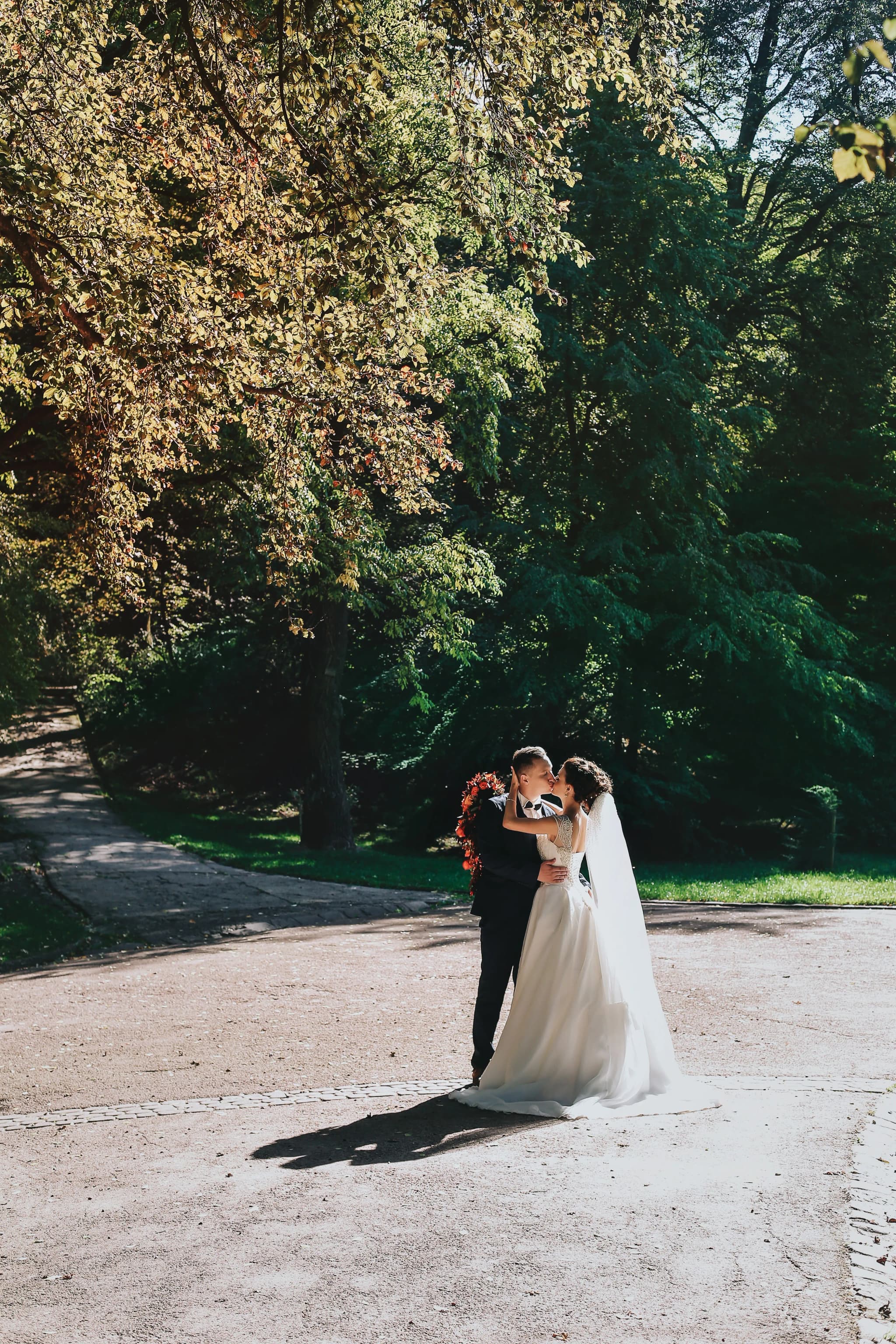
The combination of parkland and Elizabethan architecture — house and landscape designed over centuries to complement each other — creates a setting of seamless historical beauty. I favour the tree-lined avenues and the open parkland to the south of the house for relaxed, walking portraits, where the couple can simply move through the landscape rather than hold a fixed pose. The mature cedars and oaks dotted through the park also give useful shade and shelter on hot summer afternoons, which matters more than couples often expect when a wedding day runs long.
Autumn brings a different mood entirely: the parkland trees turn a rich gold and copper that pairs beautifully with the stone of the house, and the lower autumn sun works in a photographer's favour for almost the entire afternoon rather than only in the last hour before sunset.
Spring and early summer bring their own advantages. The grass is at its greenest, the specimen trees are in full leaf, and the long stretch of daylight in June and July means there is far more flexibility in when portraits can happen without racing against a setting sun. I generally recommend couples marrying in high summer build in a little contingency time around midday, since the light directly overhead in the open parkland can be harsh; the tree-lined avenues and the shaded areas near the lake become much more useful during those hours than the open lawns.
The Lion Bridge and Lake
The ornamental bridge crossing the park lake — flanked by stone lion sculptures — is one of Burghley's most photogenic features, and it is usually the location I head to first with a couple once formal family portraits at the house are finished. Portraits on the bridge with the house reflected in the lake below are among the most compelling wedding photographs it is possible to make at any English country house.
Still mornings produce the best reflections, when the lake surface is undisturbed by wind, and the long double image of house, sky, and couple in the water is particularly striking for engagement sessions timed for early in the day. For weddings, where the timing is dictated by the schedule rather than by the photographer, I still make a point of walking down to the bridge whenever conditions allow, because even a partial reflection adds real depth to the composition.
The walk from the house down to the bridge also takes couples through some of the most attractive stretches of open parkland, past mature specimen trees that make good secondary locations if time is short or the weather turns. I usually treat the bridge as the anchor location for a portrait sequence rather than a single stop, building in a few minutes either side to use the approach and the wider lakeside views as well as the bridge itself.
A note on planning your Burghley session
Burghley is a working estate with its own events calendar, so timing and access need a little forward planning rather than being left to chance. I always check the house's schedule before confirming a shoot date, and I build in enough time on the day to cover the house, the parkland, and the Lion Bridge without rushing between them. If you are considering Burghley for a wedding or an engagement session, I am happy to talk through timings and locations in detail.
Get in touch about a Burghley sessionEvents and Access
Burghley House hosts the annual Burghley Horse Trials in September — the UK's most prestigious four-day eventing competition — along with a busy schedule of concerts, fairs, and private events through the year. Couples considering Burghley for engagement sessions or post-wedding portraits should check the events calendar before settling on a date, since the parkland can be substantially altered by temporary infrastructure during the Horse Trials and other large events.
Outside major events, the parkland is generally open to visitors and provides excellent photography access, though it is still worth confirming timings directly with the estate, particularly if you want access before normal opening hours to make the most of early morning light. Wedding couples marrying elsewhere and using Burghley purely for portraits will usually need a permit arranged in advance, and I factor that into planning whenever a couple asks about using the house as a backdrop.
For couples actually marrying and holding their reception at Burghley, coordinating with the venue team on timings for the wedding breakfast and speeches makes a real difference to how much daylight is left for portraits afterwards. I always ask to see the running order in advance so I can identify natural gaps — often between the ceremony and the wedding breakfast, or during the drinks reception — when a short walk to the parkland or the bridge can happen without pulling the couple away from their guests for too long.
Proximity to Stamford
Burghley is immediately south of Stamford — itself one of the most beautiful stone towns in England, built almost entirely from the same warm limestone as the house. A combined Stamford and Burghley session gives two very different settings within a mile of each other: the golden limestone streets and medieval churches of Stamford in the morning, the Elizabethan splendour and parkland of Burghley in the afternoon.
This pairing is one of my favourite combinations for East Midlands engagement photography, and it works particularly well for couples who want variety without a long drive between locations. Stamford's narrow lanes and stone archways suit close, intimate portraits, while Burghley's scale allows for the grander, wider shots that show off the landscape. Moving between the two across a single afternoon session gives a set of images with real range, from the everyday charm of a market town to the theatrical grandeur of a great house.
If you are planning a wedding or engagement session at Burghley House, or would like to talk through pairing it with Stamford, please get in touch and I would be glad to help you plan the day around the light, the events calendar, and the locations that suit you best.

Yana Skakun
Photographer · England
Professional wedding, family and portrait photographer based in England. Passionate about capturing authentic emotions and timeless moments.
About Yana →Burghley House weddingStamford wedding photographerBurghley House wedding photographyElizabethan wedding venue EnglandLincolnshire stately home wedding
Venue Spotlights — Wedding & Portrait Photography in Cambridge & England
Yana Skakun photographs weddings and portrait sessions at venues across Cambridge, East England, London, and beyond. Venue scouting and creative collaboration are part of every booking — every location is worked with rather than against. This guide — Burghley House Wedding Photography: One of England's Most Spectacular Venues — is part of the photography journal: practical, experience-based advice drawn from real sessions across England. Whether you arrived searching for burghley house wedding or stamford wedding photographer, the same care and attention shapes every session Yana photographs.
Wedding & Portrait Photography sessions are available year-round, with bookings open across Cambridge, Ely, Huntingdon, Peterborough, and further afield — East England, London, the Midlands, and beyond. If you have specific questions about burghley house wedding photography, mention it in your enquiry. Get in touch through the contact form above to check availability and discuss your session. Enquiries are welcomed from anywhere in the UK.
Frequently Asked Questions
What should I look for when visiting a wedding venue?+
Look at the natural light at the time of day your ceremony will take place. Walk outside and consider where portraits will happen — is there an area with shade, a garden, a meaningful backdrop? Ask about vendor restrictions (some venues require you to use their preferred photographer list). Check logistics: where do guests park, where does the bridal party get ready, is there a bridal suite?
How far in advance should you book a wedding venue?+
Popular venues book 18–24 months ahead, especially for peak season (May–September) Saturdays. If you're flexible on date and day of week, 12 months is usually sufficient. Always view a venue before booking — photos online rarely show the full picture of scale, light, or atmosphere.
What questions should you ask a wedding venue?+
Ask: what's included in the venue hire? Can you bring your own caterer? What are the noise restrictions and finishing times? Is there accommodation on site? What's the plan if it rains for outdoor ceremonies? What is the minimum and maximum guest capacity? Are there any vendor restrictions or preferred supplier lists?
How do venue locations affect wedding photography?+
Venue architecture, grounds, and natural light dramatically affect the quality of wedding photography. Beautiful venues with varied backdrops, good natural light in the key rooms, and outdoor space for portraits make the photographer's job much easier. When choosing a venue, visiting at the same time of day as your planned ceremony is helpful for assessing the light.
What makes a venue photogenic for weddings?+
Natural light (large windows, north-facing rooms), textured backgrounds (stone walls, wooden beams, floral arrangements), varied outdoor spaces (gardens, courtyards, woodland, water features), and interesting architectural details. Venues that feel authentic to their setting — a barn that's actually rustic, a manor house with period features — photograph better than generic white box venues.
Continue Reading
Related Articles

Venue Spotlights
Beach and Coastal Portrait Photography in England
13 min read · Read Article
Venue Spotlights
Autumn Photography Locations in Cambridgeshire: The Complete Seasonal Guide
12 min read · Read Article
Venue Spotlights
Cherry Blossom Photography Locations in England: Where & When to Shoot
11 min read · Read Article
Get in Touch
Ready to Book Your Session?
Get in touch to discuss your vision — I'll reply within 24 hours.