Yana Skakun

Holiday Photo Tips: How to Take Better Pictures on Your UK Break
By Yana Skakun·10 July 2026·8 min read
Every summer I watch friends and clients set off for a week in Cornwall, a long weekend in the Lakes, or a few days exploring somewhere new in the UK, and every summer the same thing happens when they get home: hundreds of photos on a phone, a handful worth keeping, and a faint sense of disappointment that the pictures do not quite match the memory. This is not really a camera problem. It is a set of small, learnable habits — where you stand, when you shoot, what you leave out of the frame — that separate a snapshot from a photograph you will actually want to print. None of what follows requires expensive kit. Most of it works just as well on a phone as it does on a proper camera, and all of it is the same thinking I bring to family and portrait sessions when I am working, just adapted for the pace of a holiday rather than a booked shoot.
Why UK Holiday Photos Are Harder Than They Look
Britain is a genuinely beautiful country to photograph — soft light, dramatic coastlines, green hills that hold colour even in poor weather — but it is also a difficult place to get consistently good pictures, for reasons that have nothing to do with skill. The weather changes fast, so the light you plan around at breakfast can be gone by lunch. Many of the best-known spots are also the most crowded, which makes it hard to get a clean frame without a stranger's rucksack in the corner. And because most people are on holiday to relax rather than to work at photography, the camera tends to come out only when something looks obviously impressive, which means everything in between — the quieter, more honest moments — goes unrecorded.
The good news is that all three of these obstacles have straightforward workarounds. You do not need better weather, you need to know how to use the weather you get. You do not need an empty beach, you need to know where to stand on a crowded one. And you do not need more discipline, just a different instinct about what is actually worth photographing. That is what this guide covers.
Chase the Light, Not the Landmark
The single biggest difference between a photo that looks flat and one that looks alive is the light it was taken in, not the subject. A famous view photographed at one in the afternoon under a white sky will almost always look worse than an ordinary hillside photographed an hour before sunset. If you only change one habit from this article, make it this: build ten minutes of flexibility into your day around early morning and early evening, and use the middle of the day for driving, eating, and walking rather than for photographing.
In the UK this is easier than in hotter countries because our light is rarely harsh even in the middle of the day — but it is also rarely interesting then. Late afternoon light, particularly from spring through autumn, comes in low and warm and throws long shadows that give a landscape or a portrait actual depth. If the forecast shows broken cloud rather than clear sky, do not be discouraged; broken cloud produces some of the best light of all, with shafts of sun breaking through and moving across the landscape in a way that a plain blue sky never does.
This is the same principle that shapes when I schedule outdoor portrait sessions professionally — the golden hour either side of sunrise and sunset gives skin tones warmth and definition that midday sun simply cannot. On holiday you rarely have the luxury of a fully planned schedule, but even shifting a walk or a viewpoint visit by an hour can transform the results.
Get People Doing Something, Not Standing and Smiling
The most common holiday photograph is a family lined up in front of a view, everyone smiling on cue. These photos have their place, but they date quickly and rarely capture anything true about how the trip actually felt. Some of the images people treasure most from their own holidays are the ones where someone was caught mid-laugh, mid-splash, or mid-argument-about-the-map, because those are the moments that bring the whole day back when you look at them years later.
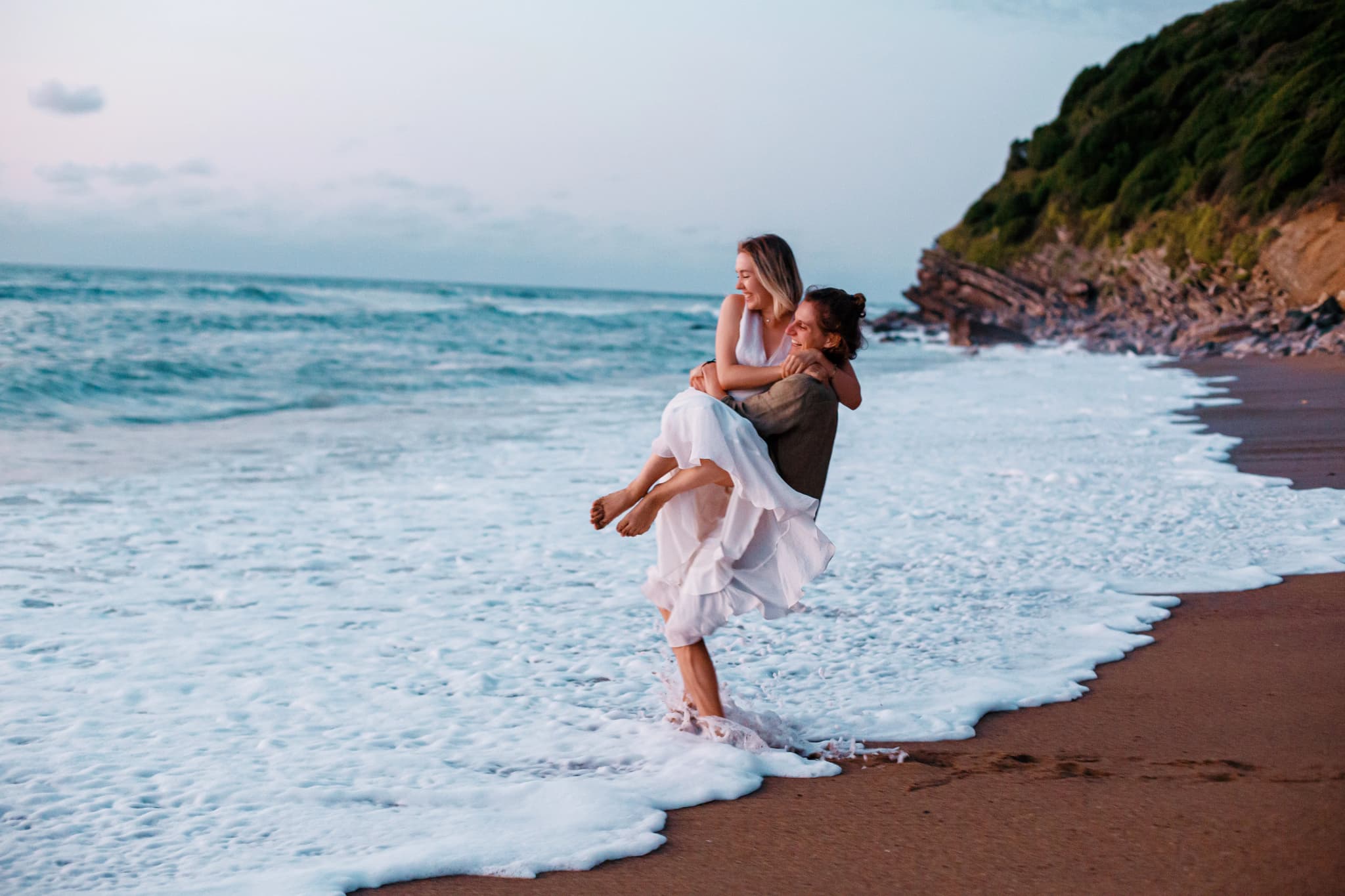
The practical version of this: instead of asking people to stop and pose, photograph them walking, paddling, eating an ice cream, reading a map, or reacting to something — a dog, a view, a wave that goes over someone's wellies. Give them something to do rather than something to perform, and take the photo a beat after you say you will, so the forced smile has relaxed into something more natural. Children in particular photograph far better in motion than standing still and told to smile; the same instinct applies to a partner or a friend who feels awkward in front of a camera.
Want the whole trip photographed properly?
If you are planning a UK break with family and would rather have someone else behind the camera for an afternoon — a coastal walk, a countryside picnic, or a few hours exploring somewhere new — that is exactly the kind of relaxed, documentary-style session I love shooting. No forced poses, just your holiday as it actually happened, properly lit and properly edited.
Get in touchComposition Habits That Take Seconds to Learn
You do not need to understand photographic theory to improve your composition instantly. A few habits, applied consistently, do most of the work. First, put your subject off-centre rather than in the middle of the frame — most phone cameras will show a grid if you turn it on in settings, and lining a person up roughly a third of the way into the frame, with the horizon roughly a third of the way up or down, almost always looks more considered than dead centre.
Second, get closer than feels natural. The most common fault in holiday photos is too much empty space around the subject — a tiny figure in front of an enormous view. Step in, or zoom in, until the person actually fills a meaningful part of the frame, then decide how much of the landscape you genuinely need behind them. Third, watch what is directly behind someone's head before you press the shutter — a lamppost, a bin, or another tourist growing out of someone's skull is the fastest way to ruin an otherwise good photo, and it takes one second to check and half a step to fix.
Finally, vary your angle. Almost every photo taken on holiday is shot from standing height, eye level, facing forward. Crouch down for a child's-eye view, shoot up at a cliff or a building to make it feel bigger, or find a slightly elevated spot — a wall, a step, a dune — and shoot down for a change of perspective. None of this needs equipment. It needs about three extra seconds of thought before each photo, which over the course of a week adds up to a noticeably better set of images.
Handling Crowded UK Locations
The most photographed spots in the UK — Durdle Door, the Lake District viewpoints, St Ives harbour, Edinburgh's Royal Mile — are popular precisely because they are worth photographing, but that popularity is also the biggest practical obstacle to a clean shot. Two things help enormously. The first is timing: arriving thirty to sixty minutes before a location's typical peak, which for coastal and countryside spots is usually mid-morning through mid-afternoon, gives you a genuinely different experience of the same place, with better light as a bonus if you go early rather than late.
The second is angle and framing rather than avoidance. You rarely need to find an empty location; you need to find the angle within a busy location that excludes the crowd. Shooting from a slightly higher or lower position than everyone else, using a doorway or a natural frame to crop out the queue behind it, or simply waiting the ten or fifteen seconds it usually takes for a gap to open in foot traffic will solve most crowding problems without needing to seek out somewhere obscure.
If you do want quieter versions of famous views, the reliable trick is to walk five to ten minutes further than everyone else is willing to walk. Most visitors cluster within a short distance of a car park; a modest uphill or coastal path walk beyond that cluster point usually earns you a much emptier frame of a similar view.
Working With British Weather Instead of Against It
A lot of holiday photography advice assumes sunshine, which is not a safe assumption for a UK break in any season. Overcast skies are actually a gift for portraits — the cloud acts as a giant diffuser, softening shadows on faces and removing the squinting that direct sun causes, so if the forecast turns grey, it is a genuinely good day for photographing people rather than a day to put the camera away. Rain is trickier but not a dead end; puddle reflections, dramatic stormy skies just after a shower, and the simple honesty of a family in raincoats having fun despite the weather all make for photographs with more character than another shot of blue sky and sunshine.
Fog and low cloud, common in the Lakes, the Highlands, and along much of the coast, create atmosphere that clear weather cannot buy — layers of hills fading into mist, a lone tree emerging from grey, a harbour softened at the edges. If you are chasing a specific dramatic sky, sunrise and sunset either side of changeable weather, rather than during a settled clear spell, tend to produce the most striking colour, because the clouds catch and hold the light in ways a plain sky cannot.
A Few Technical Basics Worth Knowing
You do not need to learn manual camera settings to take noticeably better holiday photos, but a handful of small technical habits help regardless of what you are shooting with. Wipe your phone lens before you start — a smear from a pocket or a bag is invisible on the screen but shows up as a soft, hazy patch across every photo. Turn off flash for anything beyond a couple of metres away; on a phone it does almost nothing useful outdoors and mostly just flattens faces up close.
If your phone has a portrait or depth mode, use it sparingly for people close to the camera rather than for landscapes, where it can create odd blurring around edges like hair or fence posts. And resist the urge to zoom digitally on a phone whenever you can instead move your feet closer — digital zoom on most phones degrades image quality noticeably, while walking ten steps closer costs nothing and keeps the detail sharp.
Common Questions
Do I need a proper camera, or is a phone good enough? For most holiday photography, a modern phone is genuinely good enough, particularly in good light. Where phones still struggle is low light, fast action, and situations needing real background blur behind a subject — if those matter to you, a camera helps, but the habits in this guide matter more than the equipment.
What is the best time of year for a UK holiday photography trip? Late spring through early autumn gives the most reliable combination of long days and green landscapes, but each season has its own character — autumn colour in the Lakes or the Cotswolds and winter coastal drama both photograph beautifully if you dress for it and keep expectations realistic about daylight hours.
How do I get everyone in a group photo without one person always holding the camera? A small travel tripod with a phone clip and a timer, or simply asking a friendly passer-by, solves this more reliably than the classic outstretched-arm selfie, which almost always distorts faces and cuts people out of the frame.
Should I edit my holiday photos afterwards? A light edit — straightening a horizon, adjusting brightness, a small boost to warmth — makes a real difference and takes seconds in almost any phone photo app. Heavy filters tend to date quickly; a natural, true-to-the-day edit ages much better.
If a full holiday of trying to be both the photographer and the person on holiday sounds exhausting, that is exactly the gap a booked session fills — an hour or two where someone else handles the camera and you simply enjoy the place you have travelled to. I am Yana Skakun, a Cambridge-based photographer available for family, portrait, and lifestyle sessions across the UK, whether that is a coastal afternoon, a countryside walk, or a city break. You can see more about how I work on the about page, browse general pricing, or if it is a wedding rather than a holiday you are photographing, have a look at wedding photography across the UK. For anything else, get in touch and we can talk through what would work best for your trip.
Yana Skakun
Photographer · England
Professional wedding, family and portrait photographer based in England. Passionate about capturing authentic emotions and timeless moments.
About Yana →holiday photo tips ukhow to take better holiday picturesuk break photographytravel photography tipsfamily holiday photos ukstaycation photography
Photography Tips — Professional Photography in Cambridge & England
Yana Skakun is a professional photographer based in Cambridge, specialising in wedding, family, and portrait photography across England. Every session is personal — planned around your story, your people, and the moments that matter most. This guide — Holiday Photo Tips: How to Take Better Pictures on Your UK Break — is part of the photography journal: practical, experience-based advice drawn from real sessions across England. Whether you arrived searching for holiday photo tips uk or how to take better holiday pictures, the same care and attention shapes every session Yana photographs.
Professional Photography sessions are available year-round, with bookings open across Cambridge, Ely, Huntingdon, Peterborough, and further afield — East England, London, the Midlands, and beyond. If you have specific questions about uk break photography, mention it in your enquiry. Get in touch through the contact form above to check availability and discuss your session. Enquiries are welcomed from anywhere in the UK.
Frequently Asked Questions
What camera settings should I use for outdoor portraits?+
For outdoor portraits, shoot in aperture priority mode. Use a wide aperture (f/1.8–f/2.8) to blur the background and isolate your subject. Keep ISO as low as possible in good light. In bright conditions, use a neutral density filter or switch to manual to avoid overexposure at wide apertures.
What is the golden hour in photography?+
Golden hour is the period roughly 30–60 minutes after sunrise and before sunset. The sun is low in the sky, producing warm, soft, directional light that flatters skin tones and creates beautiful long shadows. It's widely considered the best natural light for portrait and outdoor photography.
How do you get sharp photos in low light?+
In low light, increase your ISO (accepting some grain), use the widest aperture your lens allows, and slow your shutter speed to the slowest you can hand-hold without camera shake (roughly 1/focal length as a guide). Use image stabilisation if available, and consider a tripod for static subjects.
What is the rule of thirds in photography?+
The rule of thirds divides the frame into a 3×3 grid. Placing your subject on one of the four intersection points — rather than dead centre — creates a more dynamic, visually interesting composition. It's a guideline, not a rule: some of the most powerful images break it deliberately.
How do you edit photos to look professional?+
Professional editing starts with shooting in RAW format. In Lightroom or similar software, correct exposure, white balance, and contrast first. Recover shadow and highlight detail. Apply gentle colour grading for mood. Be conservative with skin retouching — the goal is natural enhancement, not transformation. Consistency across a set of images is what separates professional from amateur editing.
Continue Reading
Related Articles

Photography Tips
Photography Gift Vouchers: The Most Personal Present You Can Give
5 min read · Read Article
Photography Tips
Photo Books vs Photo Albums: What Is the Difference and Which Is Better?
5 min read · Read Article
Photography Tips
Photo Gift Ideas: Turning Professional Images into Meaningful Presents
5 min read · Read Article
Get in Touch
Ready to Book Your Session?
Get in touch to discuss your vision — I'll reply within 24 hours.