Yana Skakun

Lenses Explained: Why Professional Wedding Photography Looks Different
By Yana Skakun·10 July 2026·8 min read
Couples booking a wedding photographer rarely ask about lenses, and there is no reason they should — it is not what anyone falls in love with when they look through a portfolio. But the equipment sitting in a photographer's bag has a direct, visible effect on the final images, and it is one of the quieter reasons why professional wedding photography looks different from photographs taken by a talented guest with a good camera. Lenses shape depth, distortion, low-light performance, and the emotional feel of a photograph long before editing ever comes into play. Understanding a little about how they work makes it much easier to see what you are actually paying for when you book a professional wedding photographer, and why the same scene can look completely different depending on what glass is in front of the sensor.
Focal Length: Why the Same Room Can Look So Different
Focal length, measured in millimetres, determines how much of a scene a lens captures and how compressed or expansive that scene appears. A wide lens, something like 24mm or 35mm, takes in a broad field of view and exaggerates the sense of space between foreground and background. A longer lens, 85mm or 135mm, narrows the field of view dramatically and compresses distance, pulling background elements visually closer to the subject and creating that flattering, slightly telephoto look you see in most classic bridal portraits.
This matters enormously on a wedding day because the same room can be photographed in two completely different ways depending on the lens chosen. A wide lens during the ceremony shows the full context — the venue, the guests, the architecture — and tells the story of the day as a whole. A longer lens isolates two faces during the vows, blurring everything else into a soft wash of colour so nothing distracts from the couple's expressions. Professional wedding photography moves between these two approaches constantly and deliberately, choosing focal length scene by scene rather than shooting everything from one spot with one lens.
Aperture and the Look of Wedding Portraits
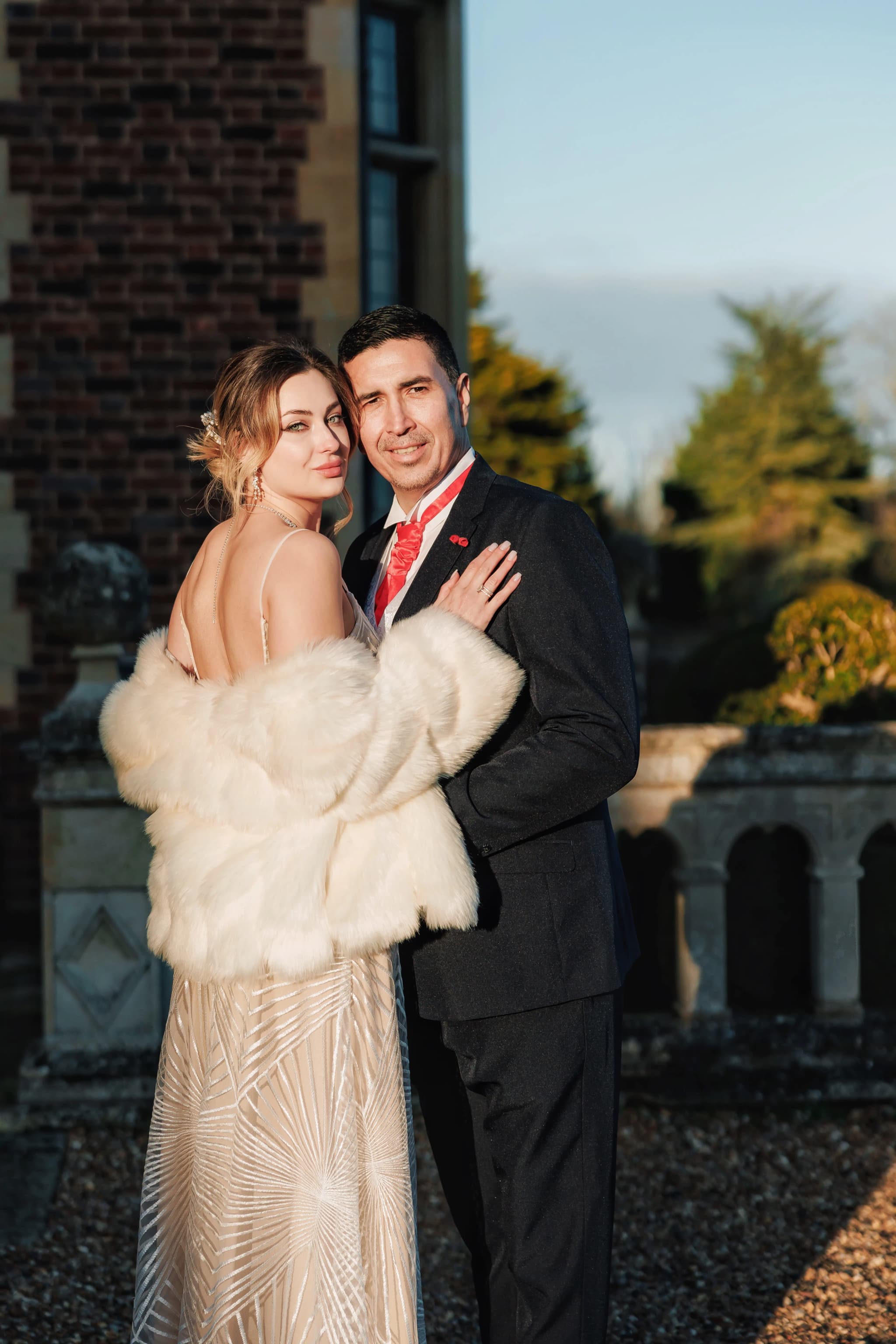
Aperture is the opening inside a lens that controls how much light reaches the sensor, expressed as an f-number such as f/1.4, f/2.8, or f/5.6. The lower the number, the wider the opening, the more light gets in, and the shallower the depth of field becomes. This is the mechanism behind the soft, creamy backgrounds you see in most professional bridal portraits — a bride in sharp focus against a field, church doorway, or row of trees rendered as gentle, indistinct colour and light.
Wide-aperture lenses, often called "fast" lenses because the wide opening also allows faster shutter speeds in low light, are a defining feature of professional wedding kit. Lenses that open to f/1.4 or f/1.8 let in significantly more light than the kit lens that comes bundled with most consumer cameras, which typically maxes out around f/3.5 or f/5.6. That difference of two or three stops is the gap between a sharp, well-exposed photograph inside a dimly lit marquee at nine in the evening and a blurry, grainy one. It is also the difference between a background that melts away softly behind the couple and one that stays distractingly sharp and busy.
The Lenses I Actually Carry on a Wedding Day
Most of a wedding day is covered with a small set of prime lenses — lenses with a single fixed focal length rather than a zoom range — because primes are typically faster, sharper, and lighter than equivalent zooms. A 35mm f/1.4 does most of the heavy lifting during getting-ready and reception coverage, wide enough to work in tight hotel rooms and crowded dance floors without stepping back constantly, but not so wide that faces distort at the edges of the frame.
An 85mm f/1.4 is the portrait lens, used for confetti shots, couple portraits, and any moment where I want the background to disappear and the couple to be the only thing the eye settles on. A 50mm sits between the two and covers ceremony moments where I need to move quickly without changing lenses. For group shots and speeches where working distance is limited by seating or venue layout, a 24-70mm zoom earns its place in the bag — not because zooms are inferior, but because some situations genuinely call for the flexibility of adjusting focal length without physically moving.
I also carry a longer telephoto, often a 70-200mm, specifically for moments where getting close would be intrusive: candid shots of guests during the ceremony, the couple walking down the aisle, or discreet coverage of a first look from a distance that keeps the moment private between the two of them.
Why this is worth asking about
When you are comparing photographers, it is entirely reasonable to ask what lenses they typically use on a wedding day. The answer tells you a great deal about how they work — whether they favour fast primes for low light and shallow depth of field, whether they carry backup bodies so a lens change never means a missed moment, and whether their kit is suited to your specific venue. I am always happy to talk through exactly what I bring and why.
Get in touchLow Light: Where Professional Lenses Earn Their Keep
UK weddings, especially those held between October and March, spend a significant portion of the day in low light — overcast ceremonies, dim marquee interiors, candlelit wedding breakfasts, and evening receptions where the only illumination is fairy lights and a DJ booth. This is precisely where the gap between professional and consumer equipment becomes most visible in the final images.
A fast lens at f/1.4 lets in roughly eight times more light than a kit lens closed down to f/4, which means the camera can use a faster shutter speed and a lower ISO setting to achieve the same exposure. Faster shutter speeds freeze motion instead of blurring it, and lower ISO settings mean less digital grain in the final image. Put simply: fast professional lenses are what allow a first dance photographed under moody, atmospheric lighting to come out sharp, clean, and full of genuine colour rather than smeared and noisy. This is one of the most concrete reasons couples notice a real difference in image quality between professional coverage and photographs taken by guests on smartphones or entry-level cameras, particularly once the sun goes down.
Sharpness, Distortion, and Why Cheaper Glass Shows It
Not every lens that reaches the same focal length and aperture number produces the same image. Lens design, the quality of the glass elements, and the precision of manufacturing all affect how sharp an image is at the point of focus, how quickly that sharpness falls off toward the edges of the frame, and how much the lens distorts straight lines — door frames, church pillars, the edge of a marquee — particularly at wider focal lengths.
Budget lenses often show visible softness toward the corners of the frame, chromatic aberration (faint colour fringing along high-contrast edges like tree branches against a bright sky), and noticeable barrel distortion on group shots that bends the row of guests at either end of the frame. Professional-grade lenses are engineered specifically to minimise these flaws, which is part of why images from a professional photographer tend to look cleaner and more polished even before any editing happens, and why venue and architectural details in the background of your wedding photography retain their true proportions rather than looking subtly warped.
Matching Lenses to Your Venue and Day
Part of preparing for a wedding is thinking through the specific spaces involved and what lens choices they demand. A small registry office with limited space behind the registrar calls for wider lenses and careful positioning to capture the couple and guests without physically being in the aisle. A grand country house with sweeping grounds rewards longer lenses that can compress a couple against distant parkland for a genuinely cinematic portrait. An intimate elopement in the Fens or the Cambridgeshire countryside often benefits from wider, more environmental lenses that show the landscape as a real character in the story, rather than reducing it to a blurred backdrop.
I always ask about venue layout in advance for exactly this reason — not to overthink the technical side, but because knowing whether a ceremony room is eight metres or twenty metres deep changes which lens is on the camera the moment the bride walks in, and there is no opportunity to adjust for that mid-ceremony.
Why This Detail Matters When You Are Choosing a Photographer
None of this is meant to turn a couple into camera experts before their wedding day. But understanding why professional wedding photography looks the way it does — the soft focus behind a portrait, the sharp low-light dance floor image, the clean, undistorted group shot — helps explain what separates a curated, deliberately built kit bag from a single camera and lens trying to cover every situation a wedding throws at it. It is also a useful lens, so to speak, through which to compare photographers: ask what they carry, why, and how they choose between options on the day. The images you eventually choose for your wedding album or wall prints are the product of hundreds of small decisions like this, made in the moment, long before any editing begins.
If you would like to talk through how I approach a specific venue, the time of year, or anything else practical ahead of booking, I am always glad to have that conversation. You can see current availability and packages on the pricing page, or simply get in touch and I will answer any questions you have. Every wedding I photograph as Yana Skakun Photography is approached with the same care in equipment choices as in everything else — because the small technical decisions are ultimately what let the genuine, unrepeatable moments of your day come through clearly.
Yana Skakun
Photographer · England
Professional wedding, family and portrait photographer based in England. Passionate about capturing authentic emotions and timeless moments.
About Yana →professional wedding photography lenseswedding photographer lenseswedding photography equipmentCambridge wedding photographercamera lenses for weddingslow light wedding photography
Photography Tips — Professional Photography in Cambridge & England
Yana Skakun is a professional photographer based in Cambridge, specialising in wedding, family, and portrait photography across England. Every session is personal — planned around your story, your people, and the moments that matter most. This guide — Lenses Explained: Why Professional Wedding Photography Looks Different — is part of the photography journal: practical, experience-based advice drawn from real sessions across England. Whether you arrived searching for professional wedding photography lenses or wedding photographer lenses, the same care and attention shapes every session Yana photographs.
Professional Photography sessions are available year-round, with bookings open across Cambridge, Ely, Huntingdon, Peterborough, and further afield — East England, London, the Midlands, and beyond. If you have specific questions about wedding photography equipment, mention it in your enquiry. Get in touch through the contact form above to check availability and discuss your session. Enquiries are welcomed from anywhere in the UK.
Frequently Asked Questions
What camera settings should I use for outdoor portraits?+
For outdoor portraits, shoot in aperture priority mode. Use a wide aperture (f/1.8–f/2.8) to blur the background and isolate your subject. Keep ISO as low as possible in good light. In bright conditions, use a neutral density filter or switch to manual to avoid overexposure at wide apertures.
What is the golden hour in photography?+
Golden hour is the period roughly 30–60 minutes after sunrise and before sunset. The sun is low in the sky, producing warm, soft, directional light that flatters skin tones and creates beautiful long shadows. It's widely considered the best natural light for portrait and outdoor photography.
How do you get sharp photos in low light?+
In low light, increase your ISO (accepting some grain), use the widest aperture your lens allows, and slow your shutter speed to the slowest you can hand-hold without camera shake (roughly 1/focal length as a guide). Use image stabilisation if available, and consider a tripod for static subjects.
What is the rule of thirds in photography?+
The rule of thirds divides the frame into a 3×3 grid. Placing your subject on one of the four intersection points — rather than dead centre — creates a more dynamic, visually interesting composition. It's a guideline, not a rule: some of the most powerful images break it deliberately.
How do you edit photos to look professional?+
Professional editing starts with shooting in RAW format. In Lightroom or similar software, correct exposure, white balance, and contrast first. Recover shadow and highlight detail. Apply gentle colour grading for mood. Be conservative with skin retouching — the goal is natural enhancement, not transformation. Consistency across a set of images is what separates professional from amateur editing.
Continue Reading
Related Articles

Photography Tips
Photography Gift Vouchers: The Most Personal Present You Can Give
5 min read · Read Article
Photography Tips
Photo Books vs Photo Albums: What Is the Difference and Which Is Better?
5 min read · Read Article
Photography Tips
Photo Gift Ideas: Turning Professional Images into Meaningful Presents
5 min read · Read Article
Get in Touch
Ready to Book Your Session?
Get in touch to discuss your vision — I'll reply within 24 hours.